
African-American Religion:
A Documentary History Project
Global Phase
Sample Documents
African Americans
and Billy Sunday in Atlanta (November–December 1917)
Documents (Continued)
African-American Religion:
A Documentary History Project |
African Americans
and Billy Sunday in Atlanta (November–December 1917) |
Copyright notice: Excerpted from African-American Religion: A Historical Interpretation with Representative Documents, edited by David W. Wills and Albert J. Raboteau (emeritus), to be published by the University of Chicago Press. ©2006 by the University of Chicago. All rights reserved. This text may be used and shared in accordance with the fair-use provisions of U.S. copyright law, and it may be archived and redistributed in electronic form, provided that this entire notice, including copyright information, is carried and provided that the University of Chicago Press is notified and no fee is charged for access. Archiving, redistribution, or republication of this text on other terms, in any medium, requires the consent of the University of Chicago Press.
32.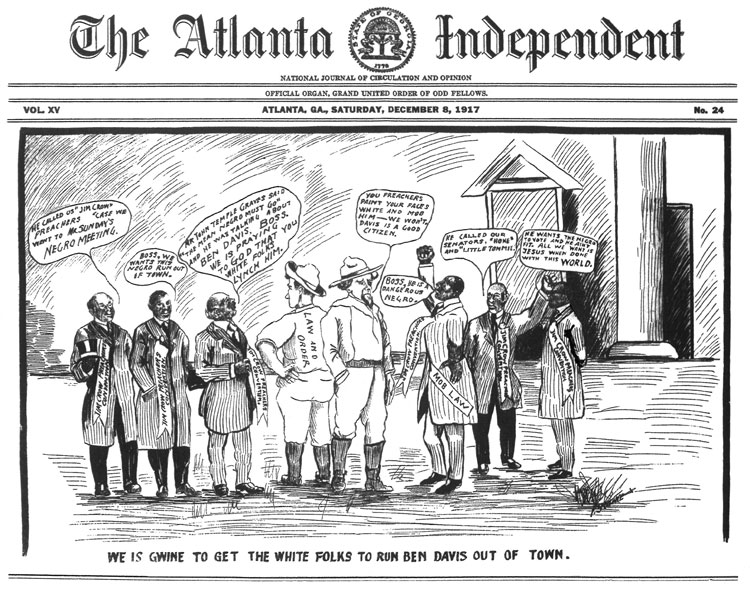
P. S. Cooke
Atlanta Independent, December 8, 1917, 1.
33. Jim Crow Preachers Bagged.
We took their measure, and the Jim Crow preacher is yelping as the hit dog always does. In our editorial a few days ago, we were careful to say in answering in the negative the question, “Is the Negro a Jim Crow Race?” that our article did not apply to all the Negro preachers, but to the Jim Crow variety; that the race had many preachers as worthy, as intelligent, as manly and as Christ-like as any other race; and that our remarks were not addressed to that class of eminent divines, but to the Jim Crow product, the “hat-in-hand,” the “yassir”–boss type, the truculent and second hand Negro preacher.
Our shot was not amiss. We filled the backs of the cowards with buckshots and their blates have been heard from every pulpit where the skunks portray their cowardice. They have yelped, whooped and bellowed, but the people know them—know them by their mouths. We took their measure, and they were the first to recognize their size and yell “Lynch him!” They have yelped loud and blatant that “We is gwine to git de white folks to run Ben Davis out of town,” but to no avail. It was Sam Jones, the noted gospel preacher, who said that it was the hit dog that yelps. “The wicked fleeth when no man pursueth.” The guilty conscience needs no accuser; it is self-condemned.
We did not name any preacher. We discussed a class, and if the Jim Crow aggregation fell into our net, we are not to blame; we were simply fishing for them. A dog knows when he is hit, and he tells the people so by his yelping. The brave, Christ-like, manly Negro preachers have kept their tongues for the reason that our shot did not hit them; but the Jim Crow character is squealing in his pulpit and in the streets like a panther because we took a pen picture of the cowardly hypocrites who hide behind the Bible to say things about men that they dare not say when they meet men, man to man.
We are satisfied that we have rendered a public service, which is the mession of The Independent. We care nothing for critisim; the truth makes us free, and the effort of the coalition of Jim Crow preachers, crap-shooters, ex-convicts, infidels and common liars to incite a race riot will have no effect either upon the editor or the policy of The Independent. We will continue to hew to the line, it matters not where the chips may fall.
A newspaper is a public institution, and its first duty is to serve the people; to defend the truth and expose error, it matters not whether the sinner is wearing the livery of a saint or is the keeper of a gaming house. We are going to do our plain duty as we have the light to see it.
It is beneath the dignity of our journal to reply to the average Negro editor or to dignify his ignorance and stupidity by giving him editorial mention; and we shall not divert from our rule on this occasion. But the audacity of these lop-eared Jim Crow sinners demands that we further expose these character assassins in the interest of society. The average Negro editor is too ignorant and stupid to separate a personality from a principle, or to discuss the point at issue on any question under debate. To differ from one of these fools, no matter what the question is, you are regarded as his life enemy.
The Independent is a newspaper that has a mission, and that mission is to perform a service to the race, community and country that no other Negro journal published in America is performing. This truth is so well established that it is not necessary for us to repeat it. Even the combination of Negro Jim Crow preachers, common scolds, infidels, crap shooters, ex-convicts and whiskey heads, who have organized for the purpose of destroying The Independent, its editor and its influence in the community, must admit that The Independent is the only Negro paper published in the Southland, that has the moral courage to stand up and fight the race’s battles Southland, that has the moral courage to stand up and fight the race’s bat under every circumstance, it matters not whether the foe is within or without the race.
The little boiler-plate, patent back sheets issued in our community, are sheets that deal only in personal abuse and vituperation. In fact, neither of them could get out an issue and leave Ben Davis’ name out of it. They do not believe that their papers would be read at all or even subscribed for if they did not carry the name of Ben Davis. They know nothing else to write about. They do not know that they are making Ben Davis; that the people love him because they hate him; that the people follow his leadership not only because his constructive genius appeals to their common sense, but largely because of the fight made against him by the character assassins who bark at his heels. He is a law-abiding citizen and has no fears of their threats, even if they are made in the pulpit behind the Bible by a polecat wearing the livery of a saint.
The white people of Atlanta stand for law and order in common with Benjamin Jefferson Davis. They are his friends because they know of his usefulness and of the service he rendering the community. And since the white people refuse to lynch a Negro in response to the demands of the Jim Crow pulpit, it is up to the aggregation of character assassins to form a mob of themselves anl compel the mean Negro to go. There are not enough Negro liars and sinners in the pulpits of this community to drive us out of town. This is our home, and we are proud of it. We are going to live, die and be buried in Atlanta; and when the cowards who revile us are in poverty, disgrace, the chaingang and in hell, we will be prospering and serving God and humanity, making places for the young men and women of our race to earn a living and to become taxpayers.
Let the Jim Crow preachers rage. Let them rant, pull their hair and slobber. Let them lock their doors, hide behind a breastwork of Bibles, and poll their congregations to see if there is a Ben Davis henchman or stool pigeon on the roost. None of these things will move us. We are going to continue to do our duty. They can tell the white folks as often as they please that the editor called our senators “Hoke” and “Little Tom” and that “Marse’ John Temple Graves said the mean Negro must go.” There are no more terrors in their threats to menace us than were in Mr. Graves’ incendiary article when he wrote it in 1904. The fools did not know that Mr. Graves is our editor’s best friend and regards him as the brainiest Negro editor on the continent.
The white folks know Ben Davis, and know his worth; and know that if it had not been for them that the aggregation of sinners, who have been plotting his overthrow for the last two years, would have succeeded if it had not been for the protection afforded him by white men. The same gang has sought to have him assassinated and have resorted to every conspiracy that hell could conjure to undo Ben Davis. But the white man has stood by Ben in every crisis. He is their friend and they are his, and so long as God reigns and directs the destiny of Ben Davis, as He has done in the past, these happy conditions will obtain in spite of the Jim Crow agitation to lynch him.
Atlanta Independent, December 8, 1917, 4.
34. Sunday Will Speak to Negroes Tonight.
The third big negro meeting will be held this evening at the Billy Sunday tabernacle, and Mr. Sunday will again deliver to the members of that race in Atlanta and those from surrounding towns, another special sermon that he has prepared for the occasion.
The great singing that has been done by the negroes at the tabernacle, and which has proven one of the great features of their meetings, will be even better tonight than on former occasions, and this is expected to be one of the best meetings that Mr. Sunday has held with the colored people.
The announcement has been made that the regular ushers on the tabernacle force will seat the people tonight, but that no white ladies, not even the ushers’ wives, will be admitted.
Atlanta Constitution, December 8, 1917, 16.
35. Third Sermon
for Negroes.
—————
White People Barred at Tabernacle Tonight Unless They Have Business There.
Saturday night will be “negro night” over at the Billy Sunday Tabernacle and Billy will preach his third special sermon to the negroes. A choir of 3,000 negro singers will provide everything in the way of music.
Here’s a tip for those planning to go over to the service:
There will be no “white folks” admitted to the Tabernacle except the ushers and doorkeepers and secretaries and those who have business there. And the Atlanta committee has requested that no white ladies go to the meeting.
This edict is to bar the wives and friends of the active workers at the Tabernacle who have been in the habit of attending the service for negroes. Last week the doorkeepers got into a batch of trouble because women insisted on getting into the Tabernacle along with their husbands and men friends who have business there.
Saturday night they will be barred entirely and as far as possible all women visitors will be refused admission. The rule applies also to men who plan to go to the service out of curiosity.
Atlanta Georgian, December 8, 1917, final edition, 3.
36. Religion
Is Obedience to God’s Command, Says Sunday.
—————
Preachers Are Criticised for Dodging Repentance.
There is a difference between fear and repentance, explained Rev. Billy Sunday in his sermon Saturday night. Repentance is born of the conviction of sin and not from fear of punishment. The sermon in full follows.
This evening the text is in Acts, the seventeenth chapter, thirtieth verse.
“God commands all men everywhere to repent.” Not I, God. God commands. He doesn’t entreat. He commands all men, the rich and the poor, the black and the white, learned or unlearned, native or foreign. He commands all men, everywhere, office, shop, store, factory, bank, legislative hall, college, university, on the street, the haunts of sin and vice—“God commands all men everywhere to repent.”
Religion is not a product of the emotions. Religion is obedience to a command of God, and God commands all men everywhere to repent.
The first thing John the Baptist preached about was repentance. The first thing the disciples preached about was repentance. It is seldom you hear a sermon on repentance today. There are plenty of preachers who in the course of a long ministry have given repentance a wide berth, possibly for the same reason that the old colored preacher never preached about stealing chickens, for he said the audience froze up toward him and people were cold.
But the man who preaches repentance in the power of God is bound to stir up snakes. It doesn’t take some preachers long to find out that it is a good deal easier to hold their job and have their salaries increased occasionally if they will make people satisfied with themselves.
All of us hate above everything else, ourselves. We all hate anything that shows us our faults or blemishes.
No photographer could make a living if he took an honest photograph of everything that comes to him for a picture. If he didn’t the retouch the negative and remove the warts and pimples the woman that had a squint and the man with a big wart on his nose would go somewhere else for a picture.
They say an elephant will not drink from a clear stream of water, because his image is reflected in the water and one sight of his ugly face throws him into a fever of wrath, and he lashes the water with fury with his trunk.
There must be a streak of human nature in an elephant.
One reason why a good many people don’t like the Bible is because it makes them see their wicked hearts and they can’t bear that. They don’t like the preaching that goes after them rough-shod and touches up the sore spots. They want the sermons of the “You-tickle-me-and I’ll tickle-you variety”—the preaching that pats them on the head and makes them feel like a boy with his mouth full of butterscotch is good preaching to them.
You make a man feel as though God admired him and couldn’t run this universe without him and you will be a great preacher to that fellow.
Well, John the Baptist wasn’t that kind of preacher; neither was Jesus Christ, neither were the disciples, except Judas. That’s why John was put in prison. That’s why they cut off his head. He opened the Bible square in the middle and cried, “Repent, repent,” and he took dead aim at the old sinners in front. No wonder he stirred up a hornet’s nest.
“Personal Devils”
Whenever you hear a preacher say that he doesn’t believe in a personal devil, you can bet thousands of dollars to doughnuts that he never preached a sermon on repentance, for if he had he would know there was a devil, for he would have heard him roar against his preaching always.
A sinner couldn’t feel comfortable under the preaching of John the Baptist. He held up the clear glass of God’s word and let them see their faces. Oh, John had a backbone bigger than some men’s bodies, that I have met—and with no more flinch in his preaching than you could have found in a Quaker meeting. He cried out to King Herod, “It isn’t lawful for you to have your brother Philip’s wife; you are living in sin.”
That’s why they laid violent hands on John. That’s why they threw him in prison and cut off his head. The keen edge of John’s preaching guillotined him. He dared tell the king on the throne what God thought of him if he lived in sin.
And if you want to hear the devil’s gang roar, howl, you try to be decent and do something for God in the name of Jesus Christ, and they will cuss you and damn you and jump on you with both feet, just as they did in the days of Jesus Christ when two blind men sat by the wayside begging and crying, “Thou son of David, mercy upon us.”
They said, “Hold your peace, shut up, shut up.”
And they yelled “shut up” when the multitudes talked about the tabernacle and talked about going to the temple.
“Shut up, Billy is vulgar!”
“Shut up, he is a grafter!”
“Shut up, he uses slang!”
They yelled at Stephen when he told them they were uncircumcised in heart and they were living in sin, and they stoned him to death.
“Shut up” they yelled to Paul and they wound chains around him and threw him in prison and then they chopped off his head.
“Shut up” they yelled to John as he held up the bleeding form of Jesus Christ.
“Shut up” they yelled at Savonarola. They incinerated him in the square because he preached Jesus Christ and told the crooks of his day where to “head in.”
“Shut up” they shouted at John Bunyan, and they turned the keys on him in Little Bedford’s jail.
“Shut up! don’t talk about the Tabernacle. Shut up! Keep still! It hurts our business and people are getting their eyes open. They are going home and kissing their wives instead of beating them up. Girls are going square, and young fellows are throwing their arms around their fathers.
“Shut up! Why we can no longer feed and fatten and gormandize upon the virtue of men and women, for they are being torn loose from the thraldom of their transgressions.”
A very notable and respectable man was brought into court on the charge of wrong-doing, and the only eyewitness was an itinerant fiddler.
“What is your name?”
“Joe, the Fiddler.”
“Where do you live?”
“Nowhere in particular.”
“Where do you play?”
“Nowhere in particular. In saloons, in bawdy houses, in dance halls.”
“Ever been in court before?”
“Yes.”
“Ever been convicted?”
“A good many times.”
“Ever been a witness before?”
“Yes.”
“Always been the criminal on trial before, haven’t you?”
“Yes.”
“Why do you want to testify against this man? Have you got a personal grudge against him?”
“Yes. He said my playing was hurting boys and girls and luring them into these places of sin.”
“You are discharged,” said the Judge to the prisoner. “The only witness against you is an itinerant fiddler who is doing all he can to curse the world. He has no standing in this world.”
The Devil on Trial.
Suppose I summoned the devil on the witness stand and said, “Sit down, devil, what is your name?”
“My name is the devil.”
“Any other name?”
“The serpent.[”]
“Any other?”
“Yes, roaring lion.”
“Any other?”
“The father of lies.”
“You’ve got several aliases, haven’t you?”
“Yes.”
“You sometimes appear in the guise of a college professor, don’t you?”
“Yes.”
“You sometimes appear in the guise of a preacher without reverence for God, don’t you?”
“Yes.”
“Sometimes you appear in the guise of an editor, don’t you?”
“Yes.”
“Sometimes you appear in the false guise of a truth seeker, don’t you?”
“Yes.”
“You are a regular Sherlock Holmes for disguises, aren’t you?”
“Yes.”
“Have you got any special grudge against the tabernacle and revival?”
“Yes. It is putting me out of business. We have to close up the saloons and distilleries, and the places where we lure young men and women to ruin and drag them away from God.”
“Oh,” says the Judge of the Universe, “Bily, you are acquainted. The only witness against you is an old whisky-soaked, good-for-nothing, fiddling, carousing, old devil! He has done nothing but curse and damn this old world. You can go to Heaven, Billy. You can go to Heaven.”
Like a little boy said: “Pa, is the devil big?”
“Yes.”
“Is he bigger than you, pa?”
“Yes.”
“Is he bigger than Jesus?”
“No, my boy.”
“Then I am not afraid of him.” Neither are you.
Some preachers if they were as true and preached to the old Shylocks on their board as they ought to, they’d be turned out to graze but they’d be turned into Heaven.
Non-Committal Preachers.
I know preachers, and perhaps you do, who would have been so non-committal in their preaching that the leacherous, old king would have been shouting happy every time he heard them. They would have even catered to his vanity in their prayers, thanking God that He had placed over them such a virtuous king, one who knew the true religion and had a double portion of it. There were plenty of Pharisees who would have rubbed the fur the right way to secure the compliments every time they opened the sacred parchment, my friends,
A fellow said to me, “Bill, you rub the fur the wrong way.”
I said, “I don’t. Let the cat turn around.”
When John the Baptist saw that chariot drawing up with the old Herod in it and that sinful woman, he said, “Lord, help me to hit that old sinner square between the eyes.”
And to make sure there was no misunderstanding of his message and what he was preaching about, he pointed to the sinful woman that was lolling on the purple cushion in the chariot and with words that drew blood like a Damascus sword, he said: “It isn’t lawful for you to have her, you bring forth meat for repentance by putting her away.”
Oh, a long step has been taken in maintaining a high standard of individual and public morals when sins are called by their right names: grossness, vileness, rottenness, drunkenness.
Most people take poison through misunderstanding. If every bottle containing poison would be marked with the skull and cross bones, there wouldn’t be so many that would take it.
I have read in the papers within the last few months where twenty-odd people have taken bichloride of mercury, thinking it was a sort of headache dope. Bichloride of mercury will paralyze your kidneys, it will take from ten to twenty days to do it. There is absolutely nothing known in the medical science that can cure you when you take a dose of bichloride of mercury. Absolutely nothing[!] You might just as well make your will and sit down and wait for them to phone for the undertaker, for it will be fifteen to twenty days and he will come.
So, the devil appears as an angel of light and in that disguise he does his most effective work. A plain devil in sight wouldn’t tempt any decent man or woman, or anybody that wants to be respectable at all. If the devil could come up here where you would look at him, you’d hate yourself to think you were ever fool enough to do anything that the devil wanted you to do, to think that you were associated with a lobster like that.
Now I don’t believe it is a good thing to have synonyms, my friends, for sin, for lying, stealing and adultery.
Anybody who takes what doesn’t belong to him is a thief. You can call him a kleptomaniac, but that doesn’t change the fact that he is a thief.
The man who deceives his neighbor is a liar. It doesn’t make any difference what other name you put it under.
Aultery is adultery. You can call it affinity if you want to. “Thou shalt not commit affinity.”
You can put the label of peppermint on strychnine, but that won’t change the fact that the poison in the bottle is strychnine.
You call it affinity, but that don’t change the fact that it is adultery. Absolutely no! Labels don’t amount to anything.
The next thing old Herod is galloping away in his chariot, and up come his soldiers and they seize God’s lon-hearted preacher and lead him away. Perhaps he feels better now that God’s servant is in jail, but he couldn’t get away from the truth that John the Baptist had pumped into him any more than you can lock up the winds in an air box.
One of the awful things about sin is that it grows so fast. You take one drink and by the end of the year you will be taking fifty drinks. You start with one thing and it grows so fast.
John the Baptist preached repentance and all sorts of sinners came and cried out, “What must we do to be saved?”
And John told them what to do and multitudes turned from their sin.
In God’s Own Way.
God will give light to the man that is lost if you want to be saved in God’s way. You will be saved in God’s way or you will go to hell. There is no other way to be saved than God’s way. I have no way. Some fools here in town talk about Bill’s hell. You big idiots. I haven’t any hell! It is God’s, it isn’t mine! But I am preaching it to you, you false leader! You pose as though you were preaching God’s truth and you are pumping the devil’s lies into the crowd and sending them straight to hell and you will go there with the rest of them. I will tell you that much!
Now, it may help you to look at some things that repentance is not. “God commands all men everywhere to repent.”
Repentance is not fear. Oh, a good many have a mistaken idea. They think that nobody can repent in a way that will please God until he is half scared to death. Some people think that before a man can ever become a Christian, he has got to be dragged to the very brink of the pit of hell, and he has got to see the fire and brimstone and look with staring eyes into the depths of iniquity.
Oh, he has got to be filled so full of fear of God that he can’t sleep or eat, and he has got to be so filled with fear that he will turn pale and shiver and his teeth will rattle like castanets every time he sees a coffin. That isn’t so.
If a man discovers that he is on a wrong train he doesn’t need to be afraid of a holdup or a wreck. Just simply step off, and say, “This is the wrong train,” and get on the right.
All right, when you know you are living wrong a man doesn’t need to be afraid of going to hell. He can say, “This isn’t the right way to live, I am going to live right,” and then be man enough to live right for God and for God’s truth. That’s all the Lord wants you to do.
Jesus said there was an endless hell for the sinners. He only gave us one view, my friends, but that’s enough. For that view He gave us was true, and it wouldn’t help any more if He had given us a hundred. He only pulled the curtain aside once and let us look into the pit; no attempt at frightening men and women to be repentant. Repentance doesn’t come that way, and if it does, it doesn’t last any longer than the fear. When the fear is gone, religion will go with it. The man who tries to be good for fear that he will be damned if he doesn’t is no more good at heart than a lion is a lamb, or a polecat is a Guinea pig. You remove the fear of punishment and he will be about as bad as ever. Oh, you can’t scare people into heaven, no more than you can drive poison from the fangs of a rattlesnake by sticking a clothes pin on the end of his tail.
Death-Bed Repentance.
We have all seen, most of us, cases of death-bed repentances which convince us that they are uncertain. I do not say that none are genuine. I do say, I believe only a few. I don’t condemn all.
The Bible mentions one. That was the thief on the cross, but that was the first time he ever saw Jesus Christ or ever heard of Him. He accepted the first invitation. Some of you old sinners have had wagon 1oads of sermons dumped into you. You have been going to church for ten, fifteen or twenty years. You haven’t yielded, so your case is not like the theif’s on the cross. This isn’t the first chance you men and women have had to be Christians. If you had accepted Him the first chance, I wouldn’t have any sinners to preach to, for nearly everybody has had a chance to be a Christian. But this fellow’s was the first he ever had and he took it, so your case isn’t like his.
Mind you, I don’t say none are genuine, don’t misunderstand me, but nine times out of ten when a man’s afraid to die or a woman ’til the preacher has come and prayed over them, let them get well and they will be as big a devil as they were before they were sick.
Jesus didn’t say a word to the Samaritan woman about being damned; neither did he to Zacchaeus; nor to Matthew; nor the woman caught in the act of adultery. But don’t you suppose they knew what their repentance meant to them; what they had to do. Certainly they did!
If fear had been necessary, I don’t believe I’d ever been saved. I wasn’t frightened. I had no fear of God in that sense of the word. I had no special fear of what was to come. My conscience told me that I was wrong, and I wanted to be right, and I believe ninety-nine people out of a hundred want to be right. You will find one that don’t. All right, let them go to the devil if they don’t want to be right; I can’t do anything to help them any more than I am.
My conscience told me I was wrong—your conscience tells you you are wrong—and I wanted to be right. Although I am a Presbyterian, my mother was a Baptist. I married a Presbyterian girl; that’s the reason I am a Presbyterian. So if the Presbyterians are glad I am a Presbyterian, they can thank Nell that I am a Presbyterian.
Now, I heard an old Methodist preacher say that God had a heart like a father, and I knew if God had a heart like a father and loved me and I was living in sin, that He wasn’t very much to me, and I knew I’d be damned because my heart loved sin more than God, and I knew if God loved me and then I loved the thing that God hated, there wasn’t much of a man about me. There isn’t much of a man about you if you love and do the things that you know God doesn’t want you to do. There isn’t very much manhood and womanhood in you. Let’s be fair. Let’s use our reason and see where we stand on this proposition.
Now when the prodigal son out there in the midst of the squealing, hungry hogs came to himself he said, “I am a fool! I am a fool down here in a hog pen when my father has a house with a floor. I am fool eating slop when I might eat a porterhouse beef steak. I am going to cut it out. I am going home. I am going back to my father,” and he set right out for home, not because he was afraid he’d be horse-whipped if he didn’t but because he knew he was wrong down there and he wanted to be right.
So, repentance, oh, it is deeper than simply fearing the consequences of sin. Repentance is not fear; it isn’t likely to be brought about by it.
Now I don’t care what puts a man on his knees, whether he is afraid he will go to hell if he don’t repent, or whether it is because of a manifestation of the love of God through Jesus Christ that breaks his heart, and when he lives in sin, he is living against God, I don’t care what it is, only so long as you will keep out of hell and live right. I don’t care what brings you to Jesus Christ. I don’t care now.
Repentance isn’t conviction of sin alone. Many think it is. I have heard people say that’s what it is, but nobody can repent without first of all they are convicted. Nobody sends for the doctor without first of all he is convinced that he needs the doctor. A man never will be a Christian unless he is convinced that he will be a sinner.
Now men are often deeply convicted of sin, but they go right on in sin. Sometimes they will join the church, but there will be no change in their lives, and yet I have more respect for a fellow that will join the church, even if he don’t change his life than I have for the guy that won’t join the church and won’t change his life because that man may hear something thta will convert him, while this fellow won’t go to church and he is sure not to hear anything. I have got more respect for him anyway.
And sometimes they will cheat and swear and lie and commit adultery. They were convicted but they wouldn’t repent and forsake their sins and without repentance and faith in Jesus Christ nobody is right with God.
Abraham Lincoln said: “Stand with anybody when he is right; part company with him whenever he is wrong.” That’s what everybody should do.
Sin Conviction.
Old Felix was convicted, but he went right on in sin. Old Agrippa was convicted. Paul hit him under the fifth rib and he said, “Almost you persuade me to be a Christian.” Well he never did, but he was convicted. He didn’t come out cleancut on the side of Jesus Christ.
Joseph’s brothers were convicted when they killed the kid and stripped off his coat, dipped it in blood, sent it back to the father and said: “We foun[d] this coat. We don’t know whether [it] belongs to Joseph or not.”
They [li]ed! They knew it was Joseph’s coat! They were convicted but they didn’t go home and tell their father they were liars, that that coat belonged to Joseph and they killed a goat and dipped it in the blood and they sold him to the Ishmaelites. They were convicted but they didn’t tell their father they were lying.
So they keep right on many a time. And whenever a man knows he is wrong, he knows enough to repent. People are continually coming to this tabernacle, and going from these meetings, knowing they are sinners as well as they know their names, as well as they know they live, as well as they know the street they live on, and yet they won’t repent, they won’t forsake their sins. O, God, pity them, my friend! And they refuse to accept Jesus Christ.
Then first make the wrongs in your life right. Start by faith in Jesus, that’s the thing for you to do.
Now, repentance is not feeling sorry that you have done wrong. I don’t believe there is a man or woman ever lived that did wrong that didn’t feel sorry for it, especially if they get caught. I know when I was a little boy, and disobeyed my mother, oh, gee, how sorry I felt when I saw her going out with a knife to cut a switch. I was sorry then. If I had been as sorry about it before, I never would have done the thing and she wouldn’t have had to go and do that.
There is never a man or woman that goes wrong that doesn’t feel mean about it when they are alone and think it all over. I thank God that He has so ordained that no man or woman on earth can do wrong and find happiness in wrong-doing. There is no peace, saith God, to the wicked. So, there is no happiness to a sinner. I thank God that He has ordained that we can’t find happiness in sin. Absolutely you can’t do it, no matter where. You never could and you never will.
So another thing, many people are sorry they have done wrong, but they go right on in their sin. That’s the way with a drunkard. That’s the way with a thief. That’s the way with a deceiver. That’s the way with a man in a quarrel with his wife. I have never spoken in prisons—and I have spoken in prisons from Sing Sing to St. Quentin—without seeing evidences of sorrow in the men. They seem to break down, weep and pray, but when liberated, oh, so many of them go back to the same old gang, the same old haunts. Why don’t you repent and keep away from them? They were convicted, but they didn’t keep away from the influence that put them there, knowing they would do it again—not at all. So they live.
A Dramatic Incident.
In a beautiful church in a Western city some years ago, a wedding march was being played and a bride 21 years of age, a beautiful girl, came smiling and bowing down the aisle. The onlookers envied her. She was gowned in the latest creation of Redfern, the Parisian gown maker. She had a stomacher of diamonds and a rope of pearls on. She was marrying a wealthy banker, several years her senior. And people were envying her, her gown and her jewels and the life of affluence and ease they saw would be hers, and she became the bride of the man that waited for her at the altar.
As they stood there waiting, a woman with her face heavily veiled over on the left arose and hurrying to the rail, where they stood, leading a little boy 3 years old by the hand, and lifting the veil she said: “Here is your child. I have kept him for three years, now you are to be married, you can keep him the rest of the time,” and drew the veil over her face and hurried out.
The bride-to-be screamed and fainted. The music stopped, the audience gasped, and the minister stumbled and then staggered back as beads of perspiration came upon his brow. The eyes of the bridegroom-to-be were bloodshot and his lips, my friends, were dry and his face anemic. The audience fled as if from a pestilence and nobody was left, but the little boy crying for his mother, and the pale-faced, trembling banker. Oh, convicted, yes!
There are people so convicted that they can’t sleep in the world. I know men that are so convicted they are afraid to come to this tabernacle. They are afraid to put themselves under this atmosphere, and under the influence of these meetings because, as a friend of mine asked a very prominent man, “Won’t you come up to the Tabernacle?” he said.
“Gosh, I’d like to, but Billy will get me if I go.”
Isn’t it horrible? Can you imagine any respectable man or any man with good brains not wanting to be decent or a Christian? I can’t conceive it. No sir!
“God commands all men everywhere to repent.” Repentance isn’t promising that you will do better. Oh, a good many will promise they will do better and they will do it. That’s reforming. Reformation is not regeneration. What you need is not a restrained nature, but a new nature. That which is flesh, no matter whether it is white flesh, rich flesh, poor flesh, sober or drunk, what you need is to be born again. By the deeds of the law shall no flesh be justified in His sight.
So, you promised to do better, and do it. I say reform. The devil lets you promise to do better every day if you want to. If I’d ask the audience right now, “How many of you people want to do better,” I will bet, my friends, that everybody here would stand up, preachers and all. Everybody would get up.
Hold on, wait a minute! Then let me ask this: “How many of you will give your hearts to Jesus Christ and turn your back on your sins and by the grace of God you will live a life of faith in Christ from now on?”
How many would respond to that? Come on, that’s repentance. The devil will let everybody get up and say, “I want to be better.”
But when you want to walk down that aisle to say, “By faith of God, I will be a Christian,” all hell stands there to keep you back and you know it.
Good Intentions.
That’s the difference between repentance and reformation. I don’t believe there was ever a wicked man or woman on earth that didn’t promise themselves they’d be better. I know it was that way with me. I knew I was wrong without ever reading the Bible or going near a church. I don’t believe I ever did wrong in my life that I didn’t promise myself that I wouldn’t do it again. I’ll be darned if I didn’t go right out and do it again.
No man ever lies without knowing that he has done wrong. He doesn’t need to know about philosophy and science in order to know that he has done wrong when he lies. Listen, nobody ever takes advantage of another man in trade, then feels like a saint about it. No! Nobody ever ruined a trusting woman that didn’t despise himself that he did. No man ever broke into another man’s house and stole what that man had earned and saved, what that reprobate didn’t have the disposition or ability to earn without despising himself. Although he may never have been inside of a church, he knew what a sin it was. Nobody ever robbed a man of his wife’s love and felt like a saint about it. No woman ever deceived her husband, no son ever deceived his father, but they didn’t feel sorry about it. Nobody ever deceived anybody else that he didn’t feel mean about it. Why? They knew that was wrong.
Now, if feeling sorry was repentance, then the best repenters in New York are up in Sing Sing. Why there isn’t a man up there that isn’t sorry. There isn’t a man is the death house that isn’t sorry. Sorry they broke the law, sorry that they have to take the penalty for breaking the law. That’s the trouble. Sorry for that. That’s the trouble with a great many today. All over, sorry, promised to do better, certainly!
Repentance is more than feeling sorry and promising you will do better, repentance is giving up the whole thing and asking God to forgive you that you ever did. That’s repentance. That’s repentance through God. Not to tell the people; it is none of the people’s business. That might involve you and explanations wouldn’t be pleasant to make. It is nobody’s business.
A woman came to me and said, “Mr. Sunday, I want to be a Christian. I have lived in sin. Have I got to stand up and tell this audience?”
I said, “No, it’s none of their darned business what you have done. If you want to do right and serve God. Are you sorry that you ever did wrong?”
She said, “I am.”
I said, “That’s a matter between you and God. No, you don’t have to tell anybody what your sin is. That’s nobody’s business,” and it isn’t either. You do what God tells you and see how the blessing will come.
For Zacchaeus, repentance to him meant to give back four-fold to every fellow that he had stolen from. For the prodigal son, repentance to him meant to leave the hogpen and go back home. For Peter, it meant to leave the old fishing net in the boat and follow Jesus Christ. For the sinful woman, it meant to quit her life of sin; stop committing adultery and live the way she should live. For Herod, repentance meant to give up living with that sinful woman that he hadn’t any right to and live the way he should live. For you, it is your chance; for you, it is the best you will ever have. You may never hear another sermon. You don’t need to hear another sermon; you hear enough now. God is giving you all the light you need.
Evil Associations.
In many lives there is something that keeps you away from Christ. Herod’s brother’s wife was what kept him away. Whatever is keeping you away from God Almighty; whatever is keeping you from being right; give it up, or you will lose your soul. You wouldn’t walk out and make an investment if you knew that you’d lose every dollar you put in that venture. Now would you? Certainly not! You wouldn’t sit down and eat food if you knew that as soon as you ate that food you’d be sick and die, would you? No! Then why in God’s name will you live in a way that you know will take you to hell if you do? You wouldn’t do it in anything else. You wouldn’t do it if you were going to lose $1,000 or $10,000, but you will do it if you know you are going to hell, lose your soul.
If a man asked you to sell your soul for $10,000 you wouldn’t do it, and yet you will do things that will make you lose your soul.
Use horse sense and you will turn to God. The most reasonable thing in the world is being a Christian and doing God’s will and keeping His commandments and serving Him with all the power that God gives you. Lord God commands all men everywhere to repent. So, give it up, or you will lose your soul.
Herod was a king. Yes, he held a high position. He sat on a throne. There are a good many that are like him. They stand high in business, high in politics, high in club, high in lodge, high in professional life, high in educational circles, oh, they are so high up they think that if they take the stand for Jesus Christ they’d come down! No, my God, you’d climb a million miles higher than you are if you take your stand for Jesus Christ. Do you mean to say that taking your stand for Jesus Christ is coming down? I say it is leaving the devil’s subway, and going out on God’s roof garden.
When you turn your back to God, you hit the toboggan slide, and it is only a question of time until you will get to the bottom. “God commands all men everywhere to repent.”
Oh, it may be hard for you to come, I will admit that! Like the case of poor Queen Natalie of Serbia, when the war broke out, tears streamed down her beautiful face and she said, “I am going to efface myself from the crown, and the kingdom, and the courts.”
Times are so tragic in poor Serbia that those who once ruled people must now serve people. When the war broke out she was in Belgrade, and for two years afterwards she was missing. Nobody knew her whereabouts. One day a newspaper reporter strolling through the hallway of a hospital in Bordeaux, France, saw a woman with wooden shoes and heavy, wool homespun dress, and a scrub-bucket in one hand and a scrub brush in the other, and in her face he recognized Queen Natalie of Serbia. It was hard for her to leave the crown of scintillating jewels, and the robes of purple, robes of royalty, and the applause of grateful people who would kneel and kiss her hands, and scrub the floor.
It may be hard for you to come down and say by that act, “I want to be a Christian.” Did anybody think less of the Queen? No sir! She has more friends today than she ever had when she wore a crown, everywhere. “God commands all men everywhere to repent.”
All Must Repent.
You may be a big man in a church in the community, yes. But that makes no difference! The unrepentant sinner will go to hell, whether he lives in a house of fifty rooms on Fifth avenue, or a hobo in a stale beer joint, panhandling for a handout or mooching for a flap-jack.
Old Peter Cartwright, the itinerant Methodist preacher in Illinois in the days of Abraham Lincoln, was elected to congress, and he was preaching in Nashville, Tenn., with his accustomed fervor and zeal and uncompromisingly denouncing sin in all forms and phases when General Jackson entered the room and sat down in the rear, and one of the ushers pulled him by the coat and said, “General Jackson has just entered the room, not so loud, not so boisterous, not so furious in your denunciations.”
He stopped. He said, “I am just informed that General Jackson has entered the room and he is listening to me. Who is General Jackson? If General Jackson is a sinner, and doesn’t repent, he will go to hell the same as a chicken stealing nigger.”
When the meeting was over, General Jackson elbowed his way in the crowd and said, “Mr. Cartwright, I want to thank you for faithfulness to your mission and your trust in your God. You are right. If I don’t repent, and die in my sins I will go to hell, just the same as the darky will go.”
God is no respecter of persons no matter who he may be, whether he is a President in the White House or a King on a throne, or a president in a bank. God says is he doesn’t repent he will go to hell. Not I. I don’t say it. God tells you. I am just telling you what the Lord says. “God commands all men everywhere to repent.”
The unrepentant millionaire will lose his soul the same as the unrepentant clerk. The unrepentant clerk will lose his soul the same as the banker that swipes out on the bank. The unrepentant governor will lose his soul the same as the prisoner in the Tombs. The unrepentant society woman will lose her soul in heaven the same as the girl selling her virtue in the redlight. Judgment is on your trail and may overtake you before you reach home, and you may stand before God and give an account for the way you lived on earth. Before you ever eat breakfast you may have taken the last meal on this earth. The thing that God is against is the thing you have got to give up. The thing the devil is in favor of is the thing you have got to give up. The only sins that God can blot out are those that you are willing to blot out and forsake. He can do it.
Gypsy Smith was holding a meeting in Chicago some three years ago, and a man, Dr. Gonzales, called up on the telephone and said, “I wish you’d come and see me. Hire a carriage and come up to the house and I will pay the bill.”
He went to the home of the millionaire bachelor and he found that man, and he said: “I want to find Jesus Christ.”
“Well, that’s easy if you have made up your mind.”
He said: “Well, I have made up my mind, but it isn’t easy. People don’t know me. The people in my lodge don’t know me. The only one that knows is this doubted God. Mr. Smith, do you know that there is a beautiful girl buried in a western state, and that her two children and mine are in foundling homes because I haven’t got the manhood to face my sins and give them my name. If I find Jesus Christ I have got to find those children and give them my name, and my friends don’t know that and it wouldn’t be easy.”
Gypsy Smith said. “No, it wouldn’t be easy. You are right, it will mean that, but it won’t be easy. It is hard. I don’t wonder that you said you wanted to find Jesus, but it wouldn’t be easy.”
Of course it means that. Of course, the cross of Jesus Christ isn’t simply a fire escape for you to keep out of hell, while your victims go down to perdition. That isn’t the plan of this old world. If the gospel of Jesus Christ didn’t do more than that it wouldn’t be any good.
A Challenge.
I think there are wrongs in everybody’s life that you can’t make right. Isn’t that so? I know there are wrongs in my life that you can’t make right, and if I had as much sense before I was converted I wouldn’t have to regret that I ever did what I did, but it has been buried in grace for thirty years, until I can stand before this audience or any audience on God’s earth and challenge any man or woman to show anything in my life in the thirty years that I have been a Christian that I would be ashamed of. If you can, I will pay your car fare to any city in America. And if what I say isn’t true I will go to the penitentiary.
You dirty, stinking dogs, come on, come on, come on. There isn’t a man in the country that has more things framed up, they lie awake framing up things about me. Everybody here is framed up. I know that dirty, stinking gang. Darn their stinking hides!
Now he said, ‘Well, God helping me, I will, even if this city turns its back on me, and the members of my club and lodge.”
And he dispatched a messenger to a distant state. When he reached the home he found that the little girl had joined her mother in the skies. O God, pity that child and those children that come into this world through the sins of others and, God, forbid that a church would turn her back upon them. The church must be a friend to the friendless, it must open her arms and heart to those that are burdened down with the grief and sins of this old world.
They found the little boy. He had been sent to a farm and he was surrounded by people that didn’t understand him. They brought him to Chicago and you should have seen him when they took him to the rich apartments of his father. The father took the little fellow and said, “Would you like to see your father?”
He said, “I don’t know.”
He said, “Could you love him?”
He said, “I don’t know.”
He said, “Did your mother tell you of him?”
He said, “I don’t know.”
Then he said, “Would you like to live here with me?”
The little fellow cried out, “I don’t know, sir, what I want to do. I want my mamma and I want my little sister.”
The father threw his arms around him and said, “William, I am your father and this is your home, and you never need to go out any more.”
“God commands all men everywhere to repent.”
No Compromise.
Repenting is doing what God commands you with no compromising. It is no toning down half-way. It is either right or wrong.
Some one says, “I suppose you have a time every night. Bill, before you go to sleep when you fix up with God all that you have done wrong during the day.”
No! no! I wouldn’t dare to do that. Whenever God shows me I have done wrong, I fix it up right there. I don’t wait until night.
The trouble with a good many people is they do business with God on the passbook plan. They don’t fix up with God any oftener than they pay their grocery bills and some of them never do that.
I will tell you, take a tip from me. Bring your repentance right down on a spot-cash basis. Every time you do wrong, make it right, right there. Whenever you buy anything, don’t buy it if you can’t pay for it. That’s a spot cash proposition. You go to bed and go to sleep. Make it a rule in your life to get right the instant you are wrong. You will thank me as long as you live for the peace that will come to you if you will do it. Simply making good resolutions won’t free yourself from sin any more than you can cure the smallpox or diphtheria by a resolution. You must forsake it, turn your back on that sin, blot it out. Let the wicked forsake his way, no matter how pleasant that way. It may be a path of roses, it may be a dream of love, oh, but the next step may mean your immortal and eternal damnation, forsake it!
No matter how profitable the business, if you are in a business that God is against, get out of that business or it will put you in perdition. It will be a snake that will drag you to hell.
That’s the trouble with a girl selling her womanhood. If she wants to be saved she’d have to get out of the business. That’s the trouble with a lot of money you have got in the bank. You didn’t put it there honestly, you lied and swindled and cheated some fellow when you put it there, so it isn’t yours. Oh, if everything that belongs to people would leave the ones that now have it and go back to its rightful owners, there would be more equal distribution. The earnings that glisten in your ears, the diamonds and pearls would drop out and crawl to the woman who is manicuring her finger nails over a washtub and her husband beat her out of her pocketbook.
Nobody has any business to be in bad business. Nobody! Hold a dollar an inch from some fellow’s eyes and he is blind to everything that’s decent, can’t see anything in the world.
They say that John Vassar was a brewer. He became converted. Someone said, “What are you going to do with the brewery, sell it?”
He said, “If it is a bad business for me, it would be bad for somebody else.”
It didn’t need the preaching of John the Baptist to tell old Herod he was wrong.
It didn’t need any preaching to tell you that you were wrong. You knew it when you came in here. You know what sin you are holding on. I don’t know, and if I knew I wouldn’t tell. I have never mentioned any man’s or any woman’s name in connection with any sin in twenty-one years, and by the eternal God, I never will. If I knew you had committed the sins I was preahcing against I wouldn’t say anything about it. I don’t know what your sin is and I wouldn’t tell if I did. I will preach against sin with all the power I have with the hope that if sin holds you in its meshes and power that you may be disgusted and turn away from it.
You know the sin you are holding on to just the same as the merchants know it is wrong to put sand in sugar and sell cloth with a 35-inch yard stick. You know it is wrong. Here is a good thing for you.
God has put a monitor in your breast that will not let you do wrong and you not know about it.
Every man and woman knows what it is that’s keeping them away from God, and if you are not rejoicing in God’s love and forgiveness, you know why. If you are not as pure as a snowflake, you know why. If you are not as lovely as a sun-kissed mountain, you know why. If you are not as lovely as the spring morning, you know why. Why? Give your heart to Jesus Christ.
You will go to the best surgeon to have removed the putrifying abscesses that are boring their way toward your vitals. All right, kill it or it will kill you, no matter what it may be.
Voice of Conscience.
It is not for me to tell you what is wrong in your life. God has already done that through your conscience, but my place as a preacher is to cry out, Repent! Repent! Repent! Repent!—and tear away the screens behind which the sinners are hiding and back them against the wall and cry out, Repent! Repent! Repent! That’s my business as a preacher. “God commands all men everywhere to repent.”
You say, “Bill, I never killed anybody.” Yes, but you are damning other people by staying away from Christ because they are staying away because you do.
You say, “I never committed adultery.” All right, but don’t leave God, come on, be a Christian. Immediately I will forsake the thing that God points out is wrong.
With Akan it was a Babylonian farm and a wedge of gold. With you it may be illicit love, pride in dealing, I dno’t know what it is. You say, “Bill, that isn’t easy.”
I will admit it. It isn’t easy to dig out an eye or cut off a hand, but if it has to be done to save your soul, it is easy. It isn’t easy to go on the operating table and take anesthetic, but if it is the only way to save your life, it isn’t hard. You will do it, won’t you? Surely you will. If a doctor tells me I’d lose both arms or a leg or I’d die, I’d go. It would be hard, but I’d do it.
There is only one way to get out of Mammoth cave, and everybody that’s ever been lost in there that ever did get out had to go out that way. There is only one way to go to heaven and therefore everybody that’s ever saved will have to be saved through faith in Jesus Christ.
The man who will keep on in sin isn’t entitled to forgiveness. A prisoner in the penitentiary that will not promise the board of pardons that he will keep the law isn’t entitled to a parole. If he would stand up there and damn the laws and damn the president, damn the governor of the state and say he wouldn’t keep the laws if he was out, then he doesn’t deserve to be out. His place is right there, if he would do that. No, sir! God is true to you and God is true with you. God will not deceive you and God won’t let anybody deceive[.]
You come God’s way, and God will shake hands with you, and say, “Let us have peace.”
But you will have to meet under the cross. You have got to come God’s way. You had to come the government’s way.
All right, give up your sins, stop doing wrong, stop and consider. Stop to consider! That saved the prodigal Son and sent him home. He thought of his mother and father and said, “Home is better than the hog pen.”
Oh, heaven is better than hell! I am going to heaven. Jesus Christ is better than the devil. I am going to walk arm in arm with Jesus Christ. Health, that’s better than sickness. Good eyes, that’s better than blindness. Virtue, that’s better than vice. To pray, that’s better than to cuss. I am going home. I am going home to the Lord. “God commands all men everywhere to repent.”
The man that will not think puts out his eyes. He stabs himself, commits suicide, assassinates his character.
Some things God entreats people to do, but God commands sinners.
A Direct Command.
“God commands all men everywhere to repent.” God entreats some people to do things, only Christians. God doesn’t entreat a sinner to do anything. He commands a sinner and entreats his sins. Give your heart to the Lord.
You ask me, “Bill, what is repentance?” Listen. It is the immediate forsaking of anything in your life that you know to be wrong, oh, no matter what it may be. It may drive you with a whip of scorpions. It is forsaking everything you know to be wrong and asking God for Christ’s sake to forgive you.
Listen! Out in Chicago some years ago, a young business man came home from business, and he found his wife, who had been ailing, far worse. She had lost her reason. She had been sick for a long time, in a critical period of life and her mind had given away. She reached the climax and she was mad. He did what you would do if it was your wife, or what I would do if it were my wife. He quit business. He gave himself up to the care of his invalid wife.
He had a room where he kept her and she would shriek and scream out in her insanity, and the neighbors came to him and said, “Her shrieks frighten the children, and we don’t want to add to your burden and your grief, but take her away or send her to a sanitarium.”
He sent friends out and they looked through one of the suburbs and they selected a beautiful home. He purchased it. He put connoisseurs of art out to ransack the markets. He put in the decorations and the color schemes. The tapestries and draperies and fixtures all harmonized. And everything he bought—he was artistic—came.
He bought things of colors that wouldn’t clash, hoping that that would tease, and beg, and coax her mind to come back. But it did no good, she grew worse.
They had a room upstairs with grated windows where they kept her padded and in a cell. One day the door bell rang, and a committee of women from the neighborhood came in. They said, “We are sorry to have to come. We don’t want to add to your burdens, but the shrieks and screams of your wife day and night frighten us and frighten our children until they jump from their beds and come running into our rooms at night. They will take a circuitous route of two or three blocks in order to avoid going by your home on their way to and from school. We have come to say, take her away! Take her away!”
He jumped to his feet as the tears rolled down his cheeks and he said, “None of you have been in to help me in my sorrow. None of you have been here to relieve me from my lone and ceaseless vigil. Now you add to my burdens by asking me to take my wife out of her own home. Your rights stop at my line fence, my rights start there. You are on my property. I am not on yours. You are trespassers. Leave me alone with my afflicted. Go, I will not take her away![”] They went out, crestfallen. In the meantime she grew worse.
One day the old family doctor said, “George, take her down to East Tennessee, where she was born. Let her romp over the hills and let her drink from the bubbling springs, and wade barefooted in the little babbling brooks. Let her roll on the grass, George, like she did, and let her sit and lie ’neath the trees which she did when she was a little girl. Let her put the wild flowers in her hair and listen to the whippoorwill and the nightingale.”
Another Attempt.
So he put her in his private car. They took her down to East Tennessee and with attendants to watch her, he turned her loose on the farm where she spent her childhood days. She roamed over the hills and ran in the grass. They plucked wild flowers and entwined them in her hair. She waded in the little brook and drank from the bubbling streams. She sat ’neath the trees and listened to the whippoorwill and the mockingbird. But no better, she grew worse.
He put her in his private car and brought her back to Chicago. They switched it over on the other road and brought her out to the suburbs. He lifted her thin, transparent body in his arms and carried her out into the family carriage. They drove up and down the streets and he carried her upstairs. He laid her on the bed and she fell asleep.
Listen! Now, it was 10 o’clock. She slept till noon, until two. They had never known her to sleep that long without an opiate for years. They took off their shoes so they’d make no noise. She slept on. He hurried to the mayor and asked him if he would not rope off the streets so the horses wouldn’t make any noise. They stopped all the clocks in the house, everybody spoke in whispers. She slept on, on, she slept on, all night. She slept in a natural state all that night, rolled and snored. Then she slept until nearly noon the next day.
But presently she yawned, stretched her arms. She looked up, and she said, “Where am I?” Whose pretty home is this? My, isn’t it beautiful?”
She looked up into her husband’s face and said, “George, where have I been all this long time and where have you been, honey?”
He leaned over and brushed the hair back from her forehead and kissed her as the tears of joy trickled down his cheeks. He said, “I have been here all the time. I have never left you. I have been waiting, waiting, waiting.”
Where have you been? I have been standing right here by you, waiting for you to say, “I want to be a Christian, and do right.” I have been waiting, waiting.
Atlanta Constitution, December 9, 1917, 15A–16A.
37. Entire Audience of Negroes Hits Trail Saturday Evening under Negro Pastor’s Urging.
Last night saw one of Billy’s fondest wishes come true and the hitherto incomparable Rodeheaver displaced by one who, for the time, was his master in urging sinners to tread the sawdust trail. It also saw a record broken.
Billy’s hope and prayer materialized when practically the entire audience of negroes came forward at the close of the meeting and grasped his hand, and it was largely due to the efforts of Rev. D. P. Johnson, a negro minister, who took Rody’s place at lending the singing and exhorting the sinners, that the meeting closed in a spontaneous outbreak of old-time religion which made the very rafters of the tabernacle shake with fervor. Never before had so large a proportion of any audience come forward.
Billy had preached a moving sermon on repentance and a steady chorus of “Amen,” “That’s right,” “Yes, suh” and “Uh huh” showed that his audience was with him. Then he had prayed and asked the Lord to grant one of his dearest wishes, namely, that the entire audience might take a stand for Christ. But when it came to trail-hitting time it seemed as though something had gone wrong. Rodeheaver led the choir in “When the Roll Is Called Up Yonder,” but the response at best was a scattering one.
Pastor Saves Situation.
It was then that Dr. Johnson jumped into the breach and saved the situation. With a full understanding of the religious characteristics of his race, he explained that hitting the trail did not necessarily mean that the hitter had been a hardened sinner, and urged all the faithful to come up and grasp the evangelist’s hand. Then he started in a slow chant, with a pause between each line, “Come Ye Who Love the Lord.”
The response was immediate and unanimous. It seemed as though the entire audience with one accord was pressing forward toward the pulpit, while, as though sung by one great voice, the chant rolled forth.
The whole atmosphere was changed. As the negroes thronged down the aisles many shook with religious ardor while here and there could be spotted some old-time campmeeting shouters.
Rev. Johnson was soon joined by another negro minister, Rev. A. D. Williams, and the two kept the singing going until practically everyone in the tabernacle had marched to the pulpit.
Rody Watches Substitute.
Rody, in the meantime, realizing that his efforts had been surpassed, had stepped to one side, watching with delight the methods of his two substitutes. Finally, Billy had shaken the last hand and, grinning like a happy kid, stood looking out over the audience.
“It’s the greatest ever,” he said to those nearby, “the greatest ever.”
“We sure love you, Mister Billy,” someone shouted, while from another section came the cry, “Let’s stay here and sing all night.”
Billy, however, promised to preach to them again some Saturday night before the campaign was finished, and so the big night came to an end.
Billy told the negroes at the beginning of his sermon that lots of people lost their religion during bad weather, and so it seemed, for only about 800 had braved the cold to be present. Billy scoffed at those who had feared the tabernacle would not be comfortable and told about how he had preached in Buffalo with the mercury 10 below zero and five feet of snow on the ground and had filled the building for a week despite these conditions.
Rody also took a crack at “warm weather Christians” and told a story about the Dixie negro who traveled to Chicago. This negro, said Rody, had frozen stiff on the streets and someone had picked him up and taken him to the crematory and placed him in an oven over the fire. When they finally opened the oven door to take out his ashes they were greeted instead by the angry exclamation, “Hey there, white folks, shut dat door. Don’t you know you’re letting in a draft?”
No Collection Is Taken.
No collection was taken at the meeting Saturday night, Billy stating that he thought those present deserved a free show for coming out such a cold night. Moreover, he promised that just as soon as the campaign expenses were defrayed he was going to take up a collection for the negro Y.M.C.A., and try to complete the fund which that organization is now trying to raise.
On account of the small number present, the singing was not up to the usual mark, which makes it a feature of these meetings for negroes. In the absence of the regular leader, however, Secretary Trent, of the negro Y.M.C.A., led the choir in a number of typical negro religious songs, which were remarkable for their weird beauty. First there was “I Want to Be a Christian,” then “Roll Jordan,” and finally, “I Want to Be Ready,” with its ever-repeated refrain, “Walk Into Jerus’lem, Jus’ Like John.”
At the conclusion of his sermon on repentance, Billy was asked by a negro minister to preach some time in the future his famous sermon on booze to the colored folks of Atlanta. “I know that sermon is usually one for men only,” said the minister, “but some of our sisters need it, too, so we’d like to have every one allowed to come when you preach it.” So Billy promised and said that he would let the weaker sex come along also.
Atlanta Constitution, December 9, 1917, 16A.
38. Negroes Hear
Fine Sermon.
—————
Billy Delivers Hot Talk Despite Cold Wave and Small Crowd at Tabernacle.
It doesn’t take a big crowd to make Billy Sunday warm up to his subject and put over a hot sermon. Not by a long shot. Billy preached Saturday night for a mere handful of negroes one of the best sermons that he’s preached in his Atlanta campaign. He gave them a lot of good, sound doctrine, with all the frills and furbelows, and he didn’t cut it short. It was just a regulation sermon, and if there wasn’t a regulation crowd there to hear it it wasn’t Billy’s fault.
Maybe some people will any it was the fault of the weather man who sent the mercury scampering down toward zero, with a flurry of occasional snow, and the wind blowing so hard that it took the cloth signs off of the Tabernacle cars and unwrapped the fascinators from the heads of the few negro women who ventured forth to take advantage of what may be their last chance to hear the famous evangelist. But there was a surprise waiting there for those who did come. That Tabernacle was as warm as toast! Honestly, you wouldn’t have thought it possible. But once inside that big wooden building you’d never have dreamed that unusual stunts were being performed by the wind and its winter allies outside.
It did’t take long to get those several hundred negroes warmed up the tune of “Down by the Riverside,” and all the other negro hymns that have probably gained more popularity the last few weeks than they ever did before. Billy enjoyed the singing, as he always does. And he gave them a mighty good sermon in return. He said he was sorry there weren’t more people present to hear him preach, and that he believed Atlanta people were more affected by the weather than any people he’d ever seen, but he’d thank the Lord for the few that were there, and he’d preach the best he knew how for them.
He told the audience, among other things, that:
“It’s as hard for a millionaire who sins to go to heaven as it is for a crap-shooting negro.
“The banker who sins is just as much a sinner as the negro chauffeur who drives his car.
“Any man who doesn’t accept Christ is going to hell—it doesn’t matter whether he’s black or white.
“The white man who steals from the bank is just as much a thief as the negro who steals from the white man’s hen roost.”
Winnie Freeman
Hearst’s Sunday American (Sunday edition of the Atlanta
Georgian), December 9, 1917,
7A.
39. “Ma” Sunday Wins 350 Trail Hitters
“Ma” Sunday, although ill with a cold, conducted two successful meetings Sunday afternoon. Three hundred woman and children hit the trail at the close of her lecture at the Baptist Tabernacle, and more than 50, led by a blind girl, professed faith at the close of her address to more than 1,000 negroes at Big Bethel A.M.E. Church on Auburn avenue.
Atlanta Georgian, December 10, 1917, afternoon edition, 7.
40. Billy Sunday in a New Role: A Peacemaker Between the Races in the South
Mr. Sunday is now in the midst of his first great evangelistic drive in the heart of the South, and he is going over the top.
In one respect, at least, Atlanta’s preparation for the sensational evangelist was unique. In addition to the organization of the customary committees, chain of prayer meetings, groups of Bible classes, shop meetings, etc., there was another not in the all but comprehensive planning. Last May the great Atlanta fire left an extensive burned area in the heart of the residential district. On the edge of this district with its chimneys resembling tombstones in the midst of a great graveyard, the tabernacle was built. Not infrequently the evangelist refers to this fitting symbol of the type of evangel he proclaims, and with an effect that may be easily imagined.
Today Mr. Sunday makes one of his side-trips to Cartersville, the home of Sam Jones, where he will preach in the tabernacle of the late evangelist. In a way Mr. Jones prepared the South for the type of evangelist we have in Mr. Sunday. Atlanta welcomed the evangelist early in November, and at this writing (Dec. 10) there are yet two more weeks for the meetings to go. Within that time over 12,000 have hit the trail, and the record was here broken when 2,000 in a single day, mostly men, walked down the sawdust way.
But the unique feature of Mr. Sunday’s meetings in Atlanta will be their effect on the relationship of the races. Without doubt this has kept Mr. Sunday thus long out of the South. The matter came up in Baltimore, but in Atlanta a definite policy was worked out. It was tacitly agreed between the practical workers of both races in the city that we should refrain from putting upon these meetings the burden of the solution of this great problem. Accordingly the meetings began with no provision for the attendance of the colored people, save the ministers. It was felt that for black and white penitents to come down together would be an impossible undertaking under the circumstances. Of course, this put the colored race into two camps.
At length, on his fifty-fifth birthday, Mr. Sunday broke in upon his rest day and gave an extra service to the colored people exclusively, and the tabernacle which seats 12,000 was full to overflowing. One of the great features of the meeting was the singing on the part of the vast audience, which for strength and sweetness was indescribable. In turn, Mr. Sunday gave himself to the full, divesting himself of coat and collar as he warmed up to the occasion. In response over half a thousand colored people grasped his hand as an expression of their desire to lead a better life. This is unquestionably the greatest number of black people that ever gave their hand to a white man on a similar occasion.
But perhaps the most significant thing of the meeting was the prelude to the sermon. It was an appeal on the part of the evangelist for co-operation between the races. He preached again the doctrine of Booker Washington, whom he highly praised, and seemed to be answering the plea of Henry Grady in Boston for confidence in the South. The Atlanta Constitution pronounced the address epochal, and leaders among the colored people were distinctly of the opinion that a better feeling had been engendered between the races. This was manifest in practical intercourse between the races in daily life.
But the most striking proof of the good effect of the efforts at inter-racial reconciliation was in the fact that colored singers from churches and schools were invited to form the choir one evening. The announcement of this fact choked the tabernacle with the largest and most representative audience of the campaign. It was a remarkable situation—an audience of Southern white people, a choir of Southern colored people and a Northern man standing between. As one can well imagine, the very air was tense with excitement The choir of a thousand voices hurriedly gathered from schools and churches and under the direction of a skilled leader of their own race responded in grand style. No such singing had been heard before. Picked voices from the colleges led the great group which gave volume and strength to the choice singers of the occasion. Those haunting melodies, the cry of the heart of a race, were never heard to better advantage. They were a revelation to the people of Atlanta. Already many are saying that the loss of grand opera this year on account of the war can be made up for by having a Negro chorus sing the melodies of the South.
Unconsciously, perhaps, Mr. Sunday has pointed to the true method of promoting harmony between the races in the South. Already the Colored Music Festival Association organized by the First Congregational Church had discovered this, and the more progressive white people of Atlanta had recognized it. But it was left to Mr. Sunday to emphasize it in a popular way, and bring it to the attention of the masses of the people of Atlanta, and perhaps the South. The next day after the meeting Negro melodies were being hummed in every home in Atlanta. This brought master and man, mistress and maid closer together. Who knows but that in the present revolt against German music Mr. Sunday has opened the way for the development of the true American music and has forged the link that will eventually bind the races together in the South? Just as David charmed Saul with his music and drove away his madness, even so the African may charm the Saxon with his songs and assuage racial asperities. At any rate, it was highly significant that the most popular melody of the evening proved to be the one whose refrain ran, “Goin’ to study war no more!”
H. H. Proctor
Congregationalist and Advance 111, no. 52 (December 27, 1917): 933–34.
41. Billy Sunday
Pays Visit to the Home of Great Georgian.
—————
Evangelist Pays Tribute in Sermon at Cartersville to Wonderful Work Accomplished
by the Late Sam Jones.
—————
Services for Today.
Billy Sunday will preach twice in Atlanta today, resuming his campaign after an off day. His first sermon will be at 2 o’clock at the tabernacle, and at 7:30 he will preach again, both services being for everybody.
Leaving Atlanta at early hour Monday morning, Billy Sunday, accompanied by Mrs. Sunday and George Brewster, made the journey to Cartersville, where a large gathering of the friends and fellow citizens of the late Sam Jones heard him deliver one of the most magnificent sermons he has preached since he came to Georgia.
The tabernacle, being an open building, could not be heated sufficiently and the service had to be held in the Sam Jones Memorial church, which is the largest in the city and which was filled to overflowing.
Mr. Sunday was presented to the people by Rev. S. A. Harris, pastor of the church, and he related the fact that he had been received into the Methodist church by Sam Jones. He voiced his reverent memory of the late evangelist and spoke with pride his happiness in being able to introduce Billy Sunday to the people in the church that had been dedicated to the memory of Mr. Jones.
Then, with Mrs. Jones, widow of the Georgia revivalist, sitting on the rostrum with Mrs. W. H. Felton, Sam Jones’ first school teacher, and with Mr. Jones’ sister, three of his children and two grandchildren gathered in front of the pulpit, Mr. Sunday paid his predecessor in the evangelistic field one of the most beautiful tributes that has ever been given the memory of Sam Jones.
Wanted to See His Home.
“I wanted to come to Cartersville and look at the city,” said Billy Sunday, “that Sam Jones had chosen, after his travels and after seeing the most beautiful places in this country, for his home. I was anxious to see the kind of people he loved and wanted to live among. I would not have gone to any place in the country this cold morning but to Cartersville, because I wanted to see the home and the grave of the greatest evangelist of his time. The pioneer of evangelistic work. The man who had the mind of St. Paul and the heart of Jesus. The man who put the name of Cartersville on the map so that it became known in all parts of the country. No one ever qualified to stand in Sam Jones’ place. All others are imitators. God broke the mould when He made him.”
Here Billy complimented the city of Cartersville and spoke of its beautiful trees and the fine farm land that he had noticed and remarked about in the car as it passed along the portion of the Dixie highway that traversed the lower end of Bartow county. “I know fine soil, too,” he said, “for I was raised in Iowa.”
His sermon that followed was from the text, “Be ready always to give an answer to anyone that asks you.” It was a masterful address and Billy Sunday has preached no finer sermon since he came to the south.
At the close of his sermon Mrs. Sunday made a little talk, in which she expressed herself as happy to have seen and known some of the great evangelists, Sam Jones included, but said she was “happiest of all to be the wife of this man,” patting Billy affectionately upon the shoulder.
Brewster Starts Singing.
Brewster had started the meeting off with asking the congregation to sing “America” and the “Star Spangled Banner,” and then he gave the people a fine solo, which pleased them very much.
Mr. Sunday was greeted by hundreds of the friends of Sam Jones after the service was dismissed, and he spent some time shaking hands with them before going to Oak Hill cemetery, where he visited the last resting place of Mr. Jones.
Rev. L. G. Hames, of the Presbyterian church; Rev. C. L. McGinty, of the First Baptist church; Rev. S. A. Harris, of the Sam Jones Memorial church, were upon the platform while Mr. Sunday preached, and the following gentlemen made up the committee in charge of the arrangements for the meeting and the reception of the evangelist: J. B. Foster, chairman; R. M. Collins, W. C. Walton, E. G. Shaw, J. W. Vaughn, A. F. Smith, H. C. Nelson and L. W. Reeves. Mrs. Sam Jones was also upon the reception committee and accompanied Mr. and Mrs. Sunday to the cemetery and then to her beautiful home, where a fine dinner had been prepared for them.
In the home of Sam Jones Mr. Sunday showed the deepest interest in pictures of the late evangelist, in the pictures that hung on the walls, which were Mr. Jones’ favorites and in every little thing that would give him an insight into the characteristics of his former colleague.
Delighted With Dinner.
The fine dinner that Mrs. Jones had prepared for Billy Sunday seemed a delight to him, and as he progressed from course to course, he did not bear out the statement he had made at the church a few moments earlier that he was a poor eater. He did, however, unlike most preachers, pass up the fried chicken, but he passed his plate four times for “some more of that Kentucky ham,” a dish that has made Mrs. Jones’ table famous among many great personages who have sat about her board. And Billy consented three times when he was urged to have more coffee. “That’s the best ham and coffee I ever saw,” said he, and without a “by your leave,” he left the table and marched into the kitchen, saying “I want to see the one that made that coffee.” He was presented to Mat McCoy, the cook, who has been in charge of Mrs. Jones’ kitchen for the past thirty years, and Billy shook hands with the proud old servant, and thanked her for the dinner she had prepared for him. Then, turning to Katie, the house girl, who has also passed more than a third of a century in the Sam Jones home at Cartersville, he greeted her and all the other servants who been called in for the occasion.
While at the table, Billy Sunday had occupied a seat close to that of Mrs. W. H. Felton, and they talked most interestingly about many things. Billy showed a wonderful familiarity with famous Georgia characters.
He showed a particular interest in the soil of Georgia, and discussed with Moultrie M. Sessions, a guest, and a prominent real estate man, the value of Georgia soil as an investment, declaring to “Ma,” who sat at his side, that he believed he would invest some money in loans upon Georgia real estate.
Guests at Dinner.
The guests at the dinner were: Mr. and Mrs. Sunday, W. D. Upshaw, M. M. Sessions and wife, and Mrs. Horace Field of Marietta, Miss Carrie Sessions of Marietta, George Ward Cook of Haverhill, Mass.; Mr.s A. B. Cunyuns, Mrs. J. W. Jones, Miss Louella Jones, Mr. and Mrs. Rouhs Pyron, Ward Green of Atlanta, Miss Q. Winnie Freeman of Atlanta, Paul Jones, Mrs. Walt Holcomb of Nashville, Robert Porter Jones, John Holcomb, Miss Katherine Jones, Paul Jones, Jr., Mr. Skiff, Thomas P. Dunham and Mrs. W. H. Felton.
At the close of the meal all the servants were asked to come into the dining room, and W. D. Upshaw, of Atlanta, led the gathering in a most eloquent prayer.
Mrs. Jones, turning to Mr. Sunday, at the close of the prayer, with tears in her eyes, expressed her feeling of pride and gratitude that she had been privileged to become the hostess to the great evangelist, and everyone was touched as Billy replied, “I am thankful that I have been allowed to journey to this shrine.”
The evangelist and his party then made ready for the trip back to Atlanta.
Atlanta Constitution, December 11, 1917, 1–2.
42. Negroes Are Urged to Attend Meeting of Sunday Tonight
The Evangelical Ministers’ association, through its president, Rev. E. P. Johnson, pastor of the Reed Street Baptist church, is making a great effort to rally the colored people for a big turnout at the tabernacle tonight when Billy Sunday will preach his famous “Booze” sermon to the negroes of this city.
The service will begin at 8 o’clock, and it is said that ample car facilities to take care of any crowd that might gather will be provided. The tabernacle will be well heated and comfortable.
The following letter addressed to the colored people of the city, urging them to attend the meeting tonight, has been sent out by the president of the Evangelical association:
The fourth Billy Sunday meeting for the colored people of Atlanta and vicinity will be held Saturday night, December 15, at 7:30 o’clock.
Every man and woman of our race in and near the city should make special effort to be present to hear one of the most interesting and beneficial sermons ever preached in Atlanta.
All the sermons preached by Mr. Sunday to our people have been very interesting and beneficial.
The opportunity to hear this world-famed evangelist comes but once in a life-time.
Therefore all the ministers, church workers and persons interested in the religious uplift and spiritual advancement of our people and the city at large should not fail to be present at the tabernacle December 15, 1917, 7:30 p.m.
E. P. Johnson,
President of the Evangelical Ministers’ Union.
Atlanta, Ga., December 14, 1917.
Atlanta Constitution, December 15, 1917, 11.
43. Negroes Hear “Booze” Flayed.
—————
Billy Sunday Tells His Colored Audience How to Handle the Demon Rum.
“Trail the bootlegger to his lair and then tip off Chief Beavers as to the kind of business he’s doing and the place at which he is doing it, and put an end to the dive, the resort, and the joint and the criminal careers of men and women who frequent them,” was Billy Sunday’s advice to the thousand Atlanta negroes who heard his famous sermon on “Booze” Saturday night.
Old time chants, songs of anti-bellum days, modern negro church songs, eloquent and inspired prayers by shepherds of colored flocks, the singing of eight negro girls from the Leonard Street Orphanage and Billy’s promise to peach to the negroes again next Saturday night, were features of the service.
Scores of the colored folk came to the front at the end of the sermon and giving their hand to Billy, promised to renounce the ways of wickedness and lead better lives.
While the audience was small, it was better than some of the others during the week and Billy was in excellent trim.
When he got through the liquor traffic didn’t have a leg to stand on. Applause greeted all his telling blows.
Prof. W. J. Trent, secretary of the colored branch of the Y.M.C.A., lead in the singing of a number of old-time negro religious songs, among which were “Blind Man Who Stood By the Road,” and “Bye and Bye.”
The girls from the orphanage sang “My Soul Is a Witness,” and won applause by their rendition of this famous old camp meetin’ song.
The Rev. W. H fl Nelson, pastor of the Butler Street A.M.E. Church, offered prayer, asking God to shower blessings upon Billy and the great work he is doing among all creeds and all races.
Other songs were sung by the colored choir, assisted by the audience.
Then Billy assumed the leadership of the meeting.
“Folks up North go barefoot on days no colder than this,” he remarked as he rubbed him hands.
“Booze is all right in its place,” he declared, adding after a breathless pause, “but its place is in hell.”
He then asked the co-operation of the colored people of Atlanta in putting another twist in the blind tiger’s tail, and told them to help God in making right predominate in Atlanta.
The revivalist again advised Southern negroes to stay in the South, and said that they and the white folks down here were mutually dependent and mutually helpful.
Hearst’s Sunday American (Sunday edition of the Atlanta Georgian), December 16, 1917, 4A.
44. Stay in the
South, Evangelist Tells Negroes of State.
—————
Audience Applauds Statement That the Black Man Is Better Off in Dixieland Than
He Is in North.
—————
Negroes Are Advised to Help Enforce Law.
—————
If You Know of Any Mutts Selling Blind Tiger Booze, or Any Immoral Women, Tell
Chief Beavers, He Urges.
“If you know of any good-for-nothing mutts selling blind-tiger liquor; if you know of any prostitutes, tell Police Chief Beavers, so they can be put behind the bars,” was a portion of the good advice Billy Sunday gave a crowd of negroes that had gathered in the tabernacle Saturday night to hear his famous booze sermon.
The words of the evangelist were met with a storm of applause and cries of “Amen” and “Halleluia” came from all parts of the audience as Mr. Sunday proceeded: “Our soldier boys should be protected from immorality and disease, and those who would entice them to do the things that would harm them should be placed within prison doors.”
Billy also admonished the negroes about leaving the southland, saying: “I am surprised how well you people get along down here. I did not believe it from what I had heard. I can see that down here the white carpenter and the negro carpenter can work side by side, while up north they wouldn’t stand for that. The big riot that disgraced East St. Louis arose from just that question. The negro workman said he was not, and the riot resulted, with the white man, but the white man said he was not, and the riot resulted, which caused many of your race to be killed. Don’t you believe those white folks that come down here to get you to go north. They’re fooling you.” The negroes applauded Billy’s statement.
The Booze Sermon.
The crowd that had gathered numbered perhaps 1,000, white people forming a large portion of the audience, and Mr. Sunday was undecided as to whether or not to deliver the booze sermon last night or wait and deliver it next Saturday evening, when the negroes promised him a larger audience. Most of the negroes favored the postponement of the sermon, and after an amusing argument over the pulpit with the crowd of negroes Billy at last decided to give them the sermon he had chosen for the evening.
The singing was great, and as a number of songs new to both Rody and Billy were so sung by the negroes, the evangelist seemed more delighted than on any occasion since he came to the city. There were no choruses present, and the singing of the negroes was the natural sweet melody that has made the music of the southern negro famous the world over. They were not constrained by the leadership of a trained musician, nor were they embarrassed by the presence of singers who had been taught to sing, but they gave themselves over, heart and soul, to the old-fashioned negro melodies, making the best music that has yet been heard at any negro meeting held in the tabernacle.
Fine Singing.
They sung “The Blind Man Stood by the Way and Cried,” “We Will Understand It Better Bye and Bye,” “My Soul Is a Witness for My Heart,” “I Am a Soldier in the Army of the Lord,” “Down by the Riverside” and “Swing Low Sweet Chariot.”
When they had finished singing, Billy, beaming with smiles, asked them to repeat “Swing Low Sweet Chariot.”
As the evangelist proceeded though his great temperance sermon he was constantly interrupted by voices from the audience, “You tellin’ de trufe now,” “Ain’t it so?” and “Have mercy, Lord.” The eyes of the negroes would widen in surprise as Billy told them some figures regarding the saloon and what it costs to support the liquor business, and they would shake their heads and moan when he related a pathetic narrative. The responses from his audience seemed more to amuse him than to interrupt his sermon, and Billy appeared glad of the appreciativeness of his hearers.
When his powerful address was brought to a close, Mr. Sunday prayed for the negroes of Atlanta, for their educational institutions and called upon God to help them band themselves together against the evils taht prey upon them.
“I will be glad always,” prayed he, “that I have met the negroes, and heard them sing. I will tell them about it when I get to Washington—if they can sing up there like you can down here—but I am from Missouri; when they get up there they get kind of fashionable and forget to sing the good old songs. Let us all join hands with the government, and with the police, and with the churches to celan up Atlanta,” he said as he closed his unique prayer.
Stepping into the little pit at the end of the trail Billy extended an invitation to the negroes to came forward and take his hand, and give a promise for a better life. At first but four or five people came, and after exhortation from Billy and Rody, Dr. E. P. Johnson, president of the Evangelical Ministers’ association, was called to the platform. The striking figure of the old-fashioned colored minister as he took his place upon the platform gave the meeting a most picturesque and natural setting, and as he raised his voice to lead the colored congregation in the old hymn, “Amazing Grace, How Sweet the Sound,” the effect was almost instantaneous upon the people before him. The song had not proceeded through its first stanza before the negroes began to come forward, and shouting and “agonizing” of the negro mourners could be heard coming from all parts of the crowd.
“Let everybody sing. Let every sinner come,” said the leader, and as he led them into “I Am a Soldier in the Army of the Lord,” shouts of “Glory,” and “Halleluia” were heard above the voices of the singers. The negroes were coming down the aisles now in large numbers, and several women gave themselves over to the “spirit,” and were seen to sink down in their seats, moaning and crying for “mercy, Lord.”
It was an old style negro meeting, and the negroes under the influence of Billy Sunday’s sermon, the eloquent prayers of two of their ministers and the singing, abandoned themselves to their religious unction, regardless of the presence of the “white folks,” and Billy Sunday preached upon the rostrum looked at them with interest and amusement pictured upon his face. It was new to the evangelist, and he enjoyed himself like a boy at the circus. He did not say a word about not wanting to keep the audience, as he usually does, and when it was all over, and the negroes had resumed their normal attitudes, Billy asked for more. He wanted them to sing again, and he asked for “Swing Low, Sweet Chariot.”
Two features of the meeting were the prayers of Rev. F. P. Johnson and Rev. P. James Bryan, both of whom prayed eloquently, exerting much spiritual influence over the people.
In the closing prayer, Rev. Bryan prayed for the Sunday party, after returning thanks to God for the great good they had done in the city of Atlanta, and then, in most eloquent language, he pleaded with God to help the colored people to see that the same thing which would hurt a white man would hurt a negro, and the same evil that would ruin a white woman would also ruin a colored woman. “Help us to band ourselves into vigilance committee,” prayed he, “and put down the evils that would harm both races.”
Paul Jones
Atlanta Constitution, December 16, 1917, 1, 13.
Documents | Back | 1 | 2 | 3 | 4 | 5 | Next